Clarity Is the Foundation of Sustainable Speed
Why shared clarity about behavior, constraints, and impact is the real bottleneck — not writing code.

Intent is cheap. Implementation is fast. Without clarity, it’s chaos.
Software development is entering a new phase of speed. AI-assisted coding, software factories, and tighter feedback loops are compressing the time between idea and implementation. What once took weeks can now happen in days, sometimes hours. The ability to build has never been faster.
But faster building exposes a problem that has always existed: lack of clarity.
Teams are often good at describing intent, and ideas move quickly toward execution. Yet without shared clarity about what is being built, teams begin filling in the gaps with their own assumptions. The result is often rework, misalignment, and wasted effort that only becomes visible once implementation is underway.
The solution is not slowing development or adding heavier processes. It is shared clarity about how something should actually work so teams can deliver faster and with greater confidence.
One useful way to develop that clarity is to examine a capability through three lenses: mechanics, constraints, and impact.
Together they answer three fundamental questions:
- How does it work?
- What limits or shapes its behavior?
- What changes once it exists?
These lenses do not create a new process. They are simply a mental model that helps teams translate intent into something concrete as ideas evolve and implementation accelerates.
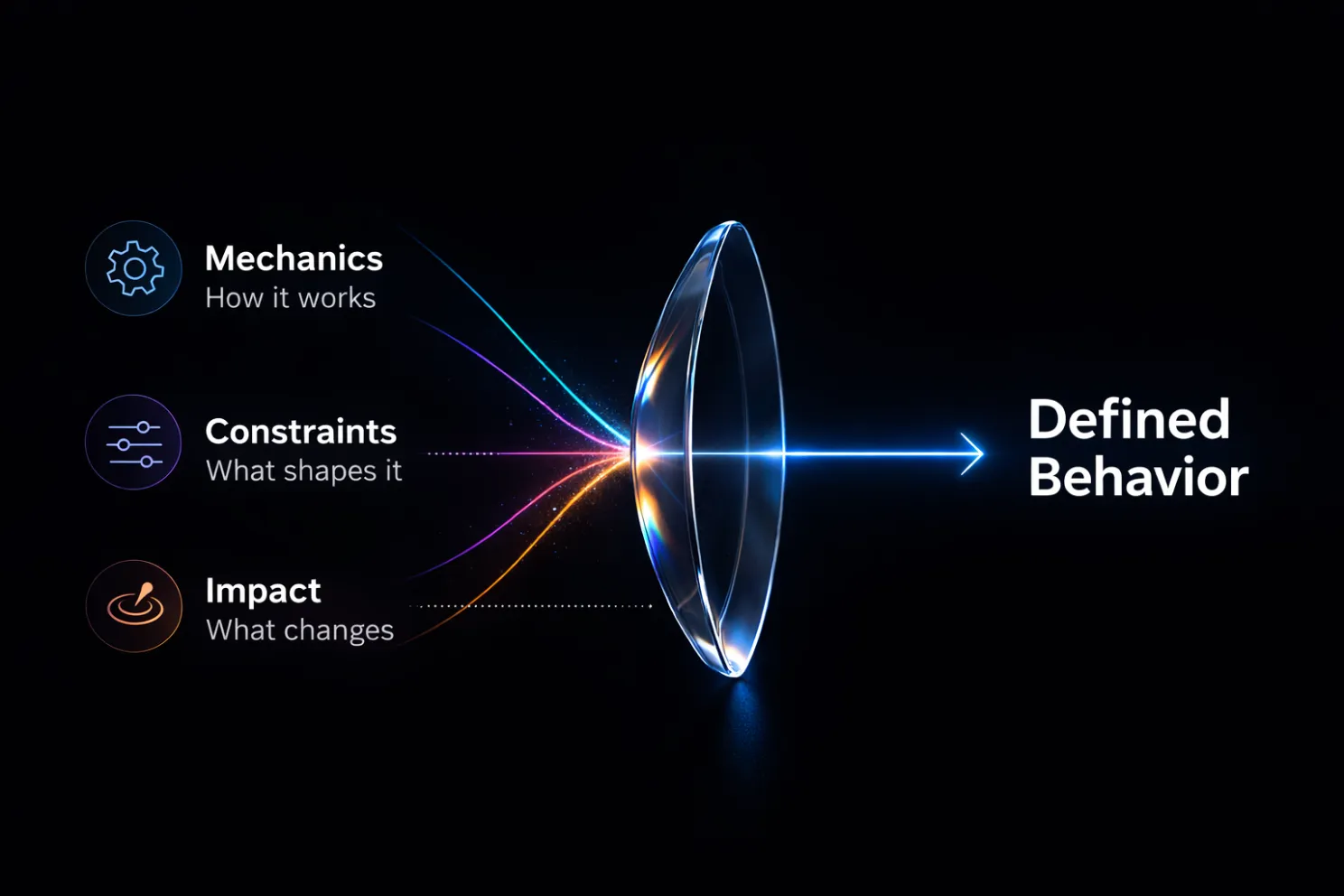
You can think of this as the missing layer between intent and implementation:
Intent —> Clarity —> Implementation
Mechanics
Mechanics describe how the product behaves — how users, systems, or agents interact with it and how the system responds.
Mechanics begin when a system receives input and produces a defined behavior. That input might come from a user clicking a button in the UI, an API call initiating a workflow, a CLI command executing an operation, an AI agent performing a task, or simply the passage of time triggering a scheduled action.
Mechanics also include the flows behind those interactions: workflows, event triggers, background jobs, and the state transitions that move activity through the system.
When teams discuss mechanics clearly, they begin answering a simple but powerful question:
What actually happens?
This conversation is not about debating implementation details. Mechanics focus on behavior — how the system responds when something occurs.
Implementation decisions often expose those mechanics, and sometimes they shape them. But the goal here is not to design the code. The goal is to define how the product behaves and how that behavior is experienced.
Until those behaviors are described explicitly, the product remains defined mostly by intent rather than operation. Late in development, disagreements often surface around details that were never clearly defined in the first place.
Constraints
Constraints define the conditions a capability must operate within.
Some constraints come from policy or governance. Permission models, approval requirements, regulatory obligations, and system rules all shape what is possible.
Others come from the realities of the systems involved. Scale, latency, cost, reliability expectations, and operational limits influence how a capability can behave once it exists.
Constraints are not only for engineers to worry about. They shape the product experience as well.
Ideas that ignore constraints often describe experiences that cannot exist in practice. But constraints should not be used to prematurely shut down ideas either. Their purpose is to ground thinking in reality so teams can explore solutions that are both ambitious and achievable.
When constraints are understood clearly, they sharpen decisions. They narrow the solution space, reveal trade-offs, and influence how mechanics should behave within the realities of the system.
The goal is not to limit creativity. It is to channel it toward solutions that can actually be built and sustained.
Impact
No capability exists in isolation.
Every new behavior introduced into a product changes something else. It may alter how users move through a workflow, shift expectations around response time, introduce operational load, or create new dependencies between systems.
Some of these effects are obvious. Many only become visible once the capability is already in use.
Even small behavioral changes can ripple through the rest of the product. A new automation may create unexpected coupling between systems. A convenience feature may introduce operational complexity elsewhere. Even a small change to the prompt of an AI agent can produce cascading effects across workflows, data, or infrastructure.
But impact rarely stops at the boundaries of the software itself.
New capabilities can influence support workflows, operational overhead, security posture, compliance obligations, marketing narratives, sales motions, pricing models, and revenue expectations. A feature designed to improve one part of the product may introduce pressure or complexity somewhere else in the organization.
Thinking through impact pushes teams to ask a broader question:
What changes once this exists?
Not just in the feature itself, but in the surrounding workflows, systems, and business operations it touches. Those consequences rarely surface from a single perspective. They emerge when multiple viewpoints examine the same capability and trace the effects it introduces across the system.
Where Perspectives Meet
Clarity does not come from a single perspective.
Product, design, engineering, and even AI systems each see different parts of the problem. In some teams those perspectives belong to different roles. In others they may exist within the same person. Either way, better decisions emerge when those perspectives are actively brought together.
This is not just collaboration for its own sake. Different perspectives surface different things. One may clarify how the product should behave. Another may reveal a constraint that changes what is feasible. Another may identify downstream effects across the system or the business.
When those perspectives stay isolated, people fill in the gaps with their own assumptions. When they actively think through the same capability together, clarity improves.
That is where better decisions come from.
AI and the Clarity Multiplier
The rise of AI-assisted development makes this translation step even more important.
Modern models can implement software quickly. Given clearly defined behavior, constraints, and expected outcomes, they can generate working systems at remarkable speed. Entire workflows, services, and integrations can emerge from a few well-structured prompts.
But that speed exposes ambiguity.
When a feature description remains mostly intent, the model still produces an answer. It fills the gaps using patterns learned from other systems. Sometimes those assumptions align with the product vision. Often they do not. The result may be technically valid code that behaves differently than the team intended.
Humans behave similarly. When intent leaves room for interpretation, each person fills in the missing pieces using their own experience and mental model of the system.
The difference is speed.
AI can move from description to implementation almost instantly. Ambiguity that once surfaced during development now appears immediately in generated behavior.
But the same tools that accelerate implementation can also accelerate clarity.
Teams can use AI to explore mechanics, surface constraints, and examine potential impacts before committing to production code. Asking “what happens next?”, probing edge cases, and testing behavioral assumptions can reveal gaps in understanding long before implementation begins.
AI does not eliminate the need for clarity. It amplifies its importance — and, when used intentionally, helps teams develop it faster.
As implementation becomes easier, the real leverage shifts to defining how a capability should behave in the first place.
Clarity as an Accelerator
None of this implies a rigid or step-by-step process. Clarity rarely appears all at once. It develops through conversation, iteration, and exploration.
Unknowns will always exist in meaningful work. Not every mechanical behavior, constraint, or impact can be identified immediately. The goal is not perfect foresight. The goal is reducing the space where people are imagining different things.
When teams reason together about how a capability should behave, what limits shape it, and what changes once it exists, they begin building from a shared understanding of reality.
In an era where building is becoming dramatically easier and faster, the primary bottleneck is no longer writing code.
It is defining behavior.
Teams that achieve clarity earlier spend less time rediscovering intent during implementation. They move with greater confidence, adapt faster when conditions change, and deliver systems that behave the way they were meant to.
Clarity is not the opposite of speed. It is what makes speed sustainable.